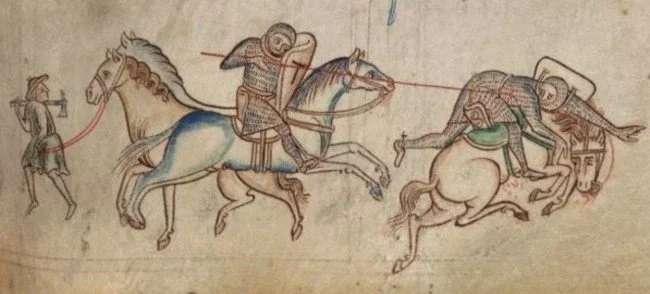
Richard Marshal unhorses Baldwin of Guines. From the Historia Major of Matthew Paris, (BL Parker MS 16 54v (88r)). Public domain, via Wikimedia Commons.
This is a story about a battle you have heard of… but it isn’t that battle…
The chief protagonist of which is Marshal, Earl of Pembroke, but not that Marshal Earl of Pembroke…
It was fought as part of a baronial rebellion aimed at controlling a king… but it isn’t that rebellion.
The battle of Monmouth, fought a trebuchet stone’s throw from my office, on the feast of St Catherine (the 25th of November) in 1233, suffers from being overshadowed on all fronts.
It shares a name with a much more famous (and for many more significant) battle fought in America in 1778. The chief protagonist - Richard Marshal - has always been overshadowed by his much more famous father, William - ‘England’s greatest knight’ (at least according to his biographer), and the cause of the battle, a struggle between established ‘English’ barons and ‘parvenu foreign favourites’, is very much in the shadow of a conflict fought over the same matters about twenty years later, led by another figure almost as famous as Richard’s father, and far more famous than Richard himself; ‘the father of English Parliaments’ Simon de Montfort, the Earl of Leicester.
The battle of Monmouth was fought as part of the so-called ‘Marshal’s War’. This conflict, which lasted barely a year between 1233 and 1234, came about as a result of two major trends of medieval history: the internecine politics of the royal court and the obligation of a lord to support his vassals.
Origins: King John and the Minority of Henry III.
The story begins with King John…
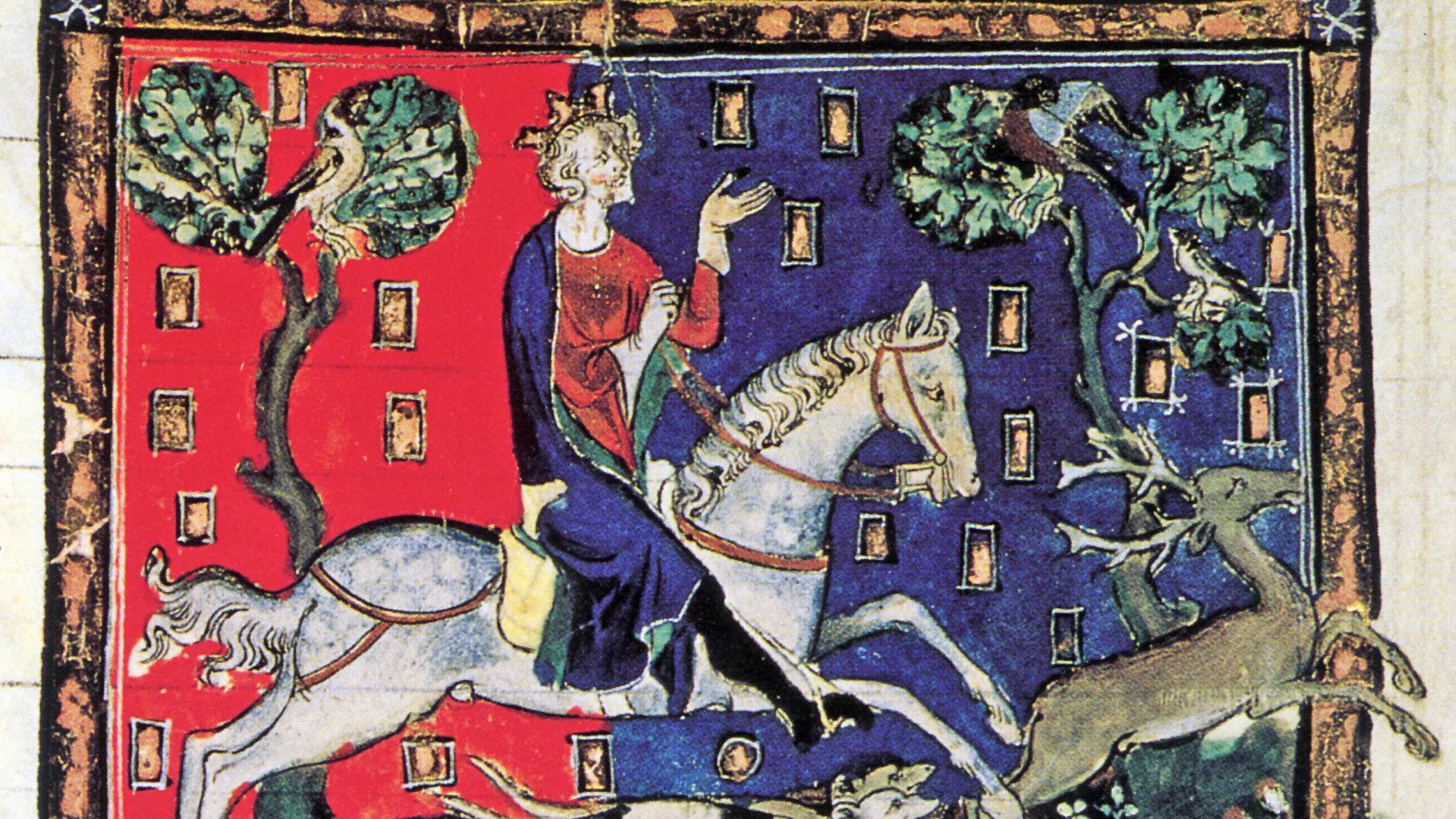
Sorry, this King John…
King John is not a good king, even by medieval standards. He was vicious and cruel, petty and duplicitous. Yes, he had been dealt a bad hand by his brother Richard, but he still mismanaged the realm badly enough to result in the rebellion of his barons and an invasion by the French heir, invited by those barons to be the new English king.
In 1215, he was forced to put his seal to Magna Carta - the Great Charter - a rather rambling document that sought to limit the king’s authority and provide protection to the barons’ rights, privileges, and power. It was repudiated almost immediately by John, with the backing of the Pope, causing a renewal of hostilities that saw the baronial rebels invite Louis, the son of the King of France, to take the throne.
John died in 1217, and those who had remained loyal to John saw to it that his ten-year-old son, Henry III, was crowned king.
The leading figure amongst these loyalists was William Marshal, Earl of Pembroke. He was very much an elder statesman. Aged 70 when John died, he had served each of the Plantagenet kings in turn, having made his name on the tournament circuit and battlefield. Henry’s royal council named him as the boy-king’s protector and regent, and William took the field again, defeating Louis’s army at Lincoln (leading a charge of knights down its steep streets). With the destruction of a fleet of French reinforcement at the Battle of Sandwich, the war was brought to a close.
William served as regent for the next two years, but in 1219, he lay dying. On his deathbed, he appointed Papal Legate Pandulf Veraccio as regent, by-passing both Hubert de Burgh, Earl of Kent, the king’s Justiciar, and Peter des Roches, Bishop of Winchester, the king’s guardian.
The pretext for this was that John had agreed to England becoming a Papal fief and that, therefore, Veraccio was acting in the name of England’s overlord, but the truth was that William Marshal didn’t really trust either the Earl or the Bishop to serve the boy-king’s best interests.
Both de Burgh and des Roches had held the position of Chief Justiciar at different points during John’s reign. John played them off against each other, building the enmity between them. Whilst alive, Marshal had managed to keep the peace between them, but with him gone, the only thing that they agreed on was that the papal legate should go. By applying pressure on the Pope, they finally achieved this in 1221, having Veraccio recalled to Rome.
With the Legate’s departure, the two men turned on each other, each trying to direct the Great Council of the nobility to back them.
Hubert de Burgh, as Justiciar and regent, held the whip hand. des Roches, despite bveing a foreigner, worked with those barons unhappy with Hubert’s strengthening royal government and yearning the independence they had achieved under Magna Carta.
In 1232, des Roches succeeded in having de Burgh arrested and imprisoned in Devizes Castle on charges of embezzlement and misconduct. Men in de Burgh's affinity found themselves out of favour at court. One of these was Richard Siward.
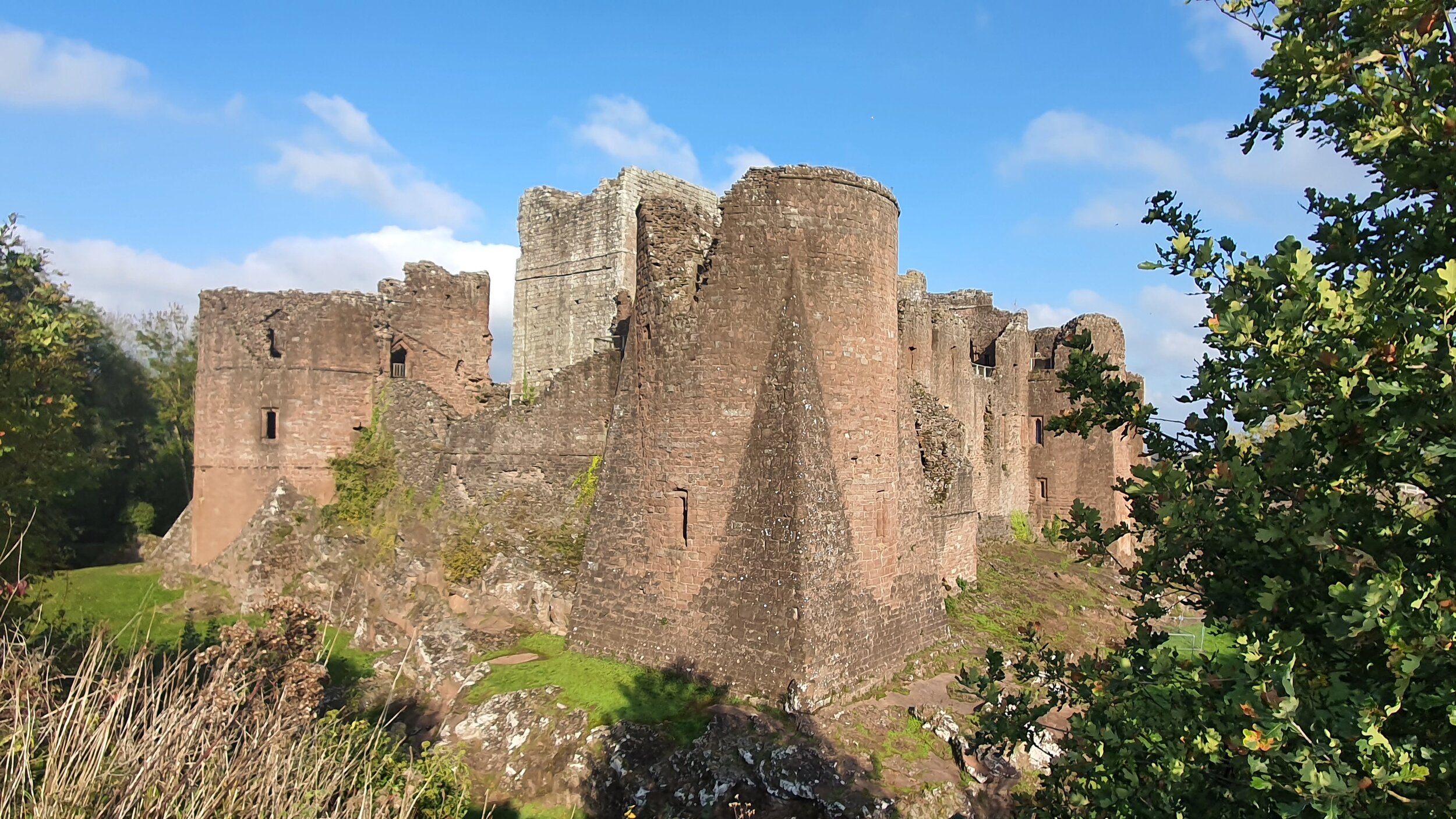
Goodrich Castle, predominantly a mid-thirteenth century rebuild by William and Joan de Valence, but with the earlier keep (contemporary with the Marshals) looming in the background. (Image: Author’s photo).
The Adventures of Richard Siward
We know very little of Richard Siward’s origins other than that he appears during the end of John’s reign as one of the household knights of William de Forze, Count of Aumarle - a baron in Yorkshire loyal to John. He then joined the household of William Marshal the Younger. The move was a natural one, as William had been fostered by Aumarle. Siward may have served as an experienced companion, much as William Marshal’s father had served Henry the Young King.
Richard served Marshal through the First Barons' War against the baronial rebels and their French allies, appearing at the battle of Sandwich. Following this, he went on to be a presence in the Marches, fighting against Llywelyn Fawr, the King of Gwynedd, and receiving wardship of William Marshal’s fourth son, Walter, and possession of Goodrich Castle.
The Marshal connection paid dividends, and in 1229 Siward was married to the widow of the Earl of Warwick, Philippa Basset. Whilst Richard did not gain the earldom itself (Philippa’s cousin, Gilbert, had secured wardship of those lands), it did provide enough lands and infliunce for Siward to be considered a baron in his own right.
He did not forget his family and lordly ties, however. When Hubert de Burgh was arrested and imprisoned, one of Peter des Roches’ entourage - Peter de Maulay - demanded the restitution of the manor of Upavon in Wiltshire, which he had lost ten years previously during a rebellion against Henry III, and which had been granted to Basset. Basset contested this, but Henry III took the part of the complainant and des Roches, and Basset was attainted as a traitor and went on the run, with Siward following him.
They headed back to the Marches and must have appealed to Richard Marshal for aid, presumably calling upon the ties of lordship that they had had with him.
(* With all the Peters, Henrys, and Richards, it is easy to become confused. The truth is there seems to have been a distinct lack of Christian names and imagination in thirteenth-century Europe.)
The Marshal War.
Richard had only just become Earl of Pembroke. On his mother’s death in 1220, he had inherited the Marshal lands in Normandy and was a liegeman of the King of France. On the death of his brother in 1231, however, he foresook both to take up the family mantle and the title.
Though he had no personal history with Basset and Siward, he clearly felt that he had a duty to them as his brother’s men and sheltered the outcasts.
Richard resisted the king’s demands to surrender the two men, but the king (and Peter des Roches) was unwilling to force the issue with the powerful marcher lord. Instead, they used negotiations and threats to put increasing pressure on the earl. In August 1233, Marshal refused to come to meet the King in Gloucester to arrange a truce between them, and royal bailiffs forced him to surrender the castle at Usk, which he did.In September, Siward and Basset launched a raid that crossed southern England. Out of Chepstow, the Marshal's stronghold, they raced through the Cotswolds, into Oxfordshire and Berkshire, grabbing the Bishop of Winchester’s personal baggage train, and dropping down into Kent before crossing all the way back across the country to return to the March.
This audacious assault caused absolute panic, and Siward capitalised on this a month later when he rode into Devizes. Here, they rescued de Burgh (who had managed to escape the castle but traded it for the equally confining sanctuary of Devizes church).*
Richard Marshal was not idle. He had clearly used the phony war of August to make plans, coming into an alliance with his old enemy Llywelyn Fawr. Llewellyn had his own personal arguments with Peter des Roches.
At the same time as Siward launched his rescue mission, Richard Marshal led his own lightning campaign, seizing the castles of Cardiff and Newport before moving up the Usk Valley to besiege and take Usk itself, then moving on Abergavenny and Grosmont. The king, who had advanced from Gloucester to Abergavenny, was unwilling to risk an encounter and retired back towards Gloucester.
Richard was free to continue his march and advanced on Monmouth with a view to besieging the castle.
(* The raid of Richard Siward would make an excellent Écorcheurs! mini-campaign.)
The Battle of Monmouth
The castle was being held by Baldwin Count of Guines, another of the Poitevin adherents of Peter des Roches, who was acting as castellan whilst its lord, John of Monmouth, was absent.
He spotted Marshal’s scouting party. The rest of the fight is well described by the chonricler Roger of Wendover, a monk of St Alban’s:
‘ … and understanding that the Marshal was there with only a few followers to examine the castle, he [Baldwin] sallied out with a thousand brave and well-equipped soldiers and pursued him at full speed, designing to make him and his followers prisoners and bring them into town.
The earl Marshal’s companions however, when they saw the impetuous advance of the enemy, advised him to consult their safety by flight, saying that it would be rash for such a few of them to engage with such a number of the enemy; to which the Marshal replied that he had never yet turned his back on his enemies in battle and declared that he would not do so now and exhorted them to defend themselves bravely and to not die unavenged. The troops from the castle then rushed fiercely on them and attacked them with their lances.’
"Baldwin and twelve of his stoutest and best armed soldiers made an attack on the Marshal in person, and tried to carry him off prisoner to the castle, but he...kept them at a distance, brandishing his sword right and left, and struck down whoever came within reach, either killing them or stunning them by the force of his blows, and although engaged single-handed against twelve enemies, defended himself for a length of time. His enemies at length, not daring to approach him, killed the horse he rode with their lances; but the Marshal, who was well practised in the French way of fighting, seized one of the knights who was attacking him by the feet, and dragged him to the ground, and then quickly mounting his adversary's horse, he renewed the battle...
Baldwin, ashamed that the Marshal defended himself single-handedly against so many foes, made a desperate attack on him, and seizing his helmet, tore it from his head with such violence that blood gushed from his nostrils and his mouth. He then seized the marshal’s bridle and tried to drag him to the castle, with others pushing him from behind. The Marshal, sweeping his sword behind him, struck two of his enemies to the earth, stunned, but could not free himself from their grasp.
At this juncture... a crossbowman amongst the Marshal's company, seeing his lord in danger, discharged an arrow from his bow, which, striking Baldwin, who was dragging the Marshal away, in the breast, entered his body, notwithstanding his armour, and he fell to the earth, believing himself mortally wounded. On seeing this, his comrade left the Marshal and went to raise Baldwin from the ground, thinking him dead.
Whilst these events were passing, news had been carried to the Marshal's army of the danger he was in, on which they marched with all haste to his assistance, and soon put his enemies to flight. A bridge in the neighbourhood of the castle, over which the fugitives hoped to make their escape, was found to be broken, on which great numbers of them threw themselves into the river and were drowned with their horses and arms; others, having no means of escape, were slain by their pursuers, and some were made prisoners, and few of those who had sallied out from the castle returned safe."
It’s a great account, full of chivalric derring-do, brave speeches and actions, and the villain of the piece, the foreigner Baldwin of Guines, being overcome and carried from the field.
We should always be careful with medieval accounts of battle. Roger of Wendover, cloistered in his abbey of St Albans in the south-east of England, was not an eyewitness to the fight. Instead, he was reliant on hearing the story of the battle second- or even third-hand. For inspiration (and because their noble audience expected it), authors would use the chivalric tales of Arthur and Roland, or draw on classical or biblical tales as exemplars. All too often, the accounts are as much about what the author and his audience felt should have happened as what actually did happen.
However, much of Wendover’s description of the battle has a ring of truth about it.
Whilst the rebels' killing of Richard’s horse was a desperate ploy and one that was generally frowned upon., it was not unheard of. Richard’s father , the great William Marshal, once unhorsed Richard the Lionheart in this manner, during a skirmish outside Le Mans in 1189. Richard had been ambushed and was unarmoured. The future king challenged William that, because of this, he couldn’t strike him personally:
‘God’s legs, Marshal! Do not kill me that would be a wicked thing to do, since you find me here completely unarmed.’ The Marshal replied: ‘Indeed I won’t. Let the devil kill you! I shall not be the one to do it.’ This said, he struck the Count’s horse a blow with his lance, and the horse died instantly; it’s never took another step forward. It died, and the count fell to the ground. It was a fine blow, which came at an opportune moment for those riding ahead.’
Back at Monmouth, Richard’s response was to unhorse one of his opponent’s by grabbing their foot and hauling them out of the saddle. It is difficult to know what to make of Wendover’s reference to it being part of the ‘the French way of fighting’. The ploy itself could have come straight for the tournament field, and, given that tournaments were far more popular and frequent in France than they were England at this time, maybe it is a reference to the tricks and tactics employed in that particular form of fighting. Given that Richard had not long come over from France it is possible that Wendover was alluding to his foreignness, but it would be an odd time in the story tom make much of it. Besides, Baldwin and many of his men were, themselves, equally French. Perhaps Wendover was merely trying to show that Richard was a great warrior, every bit the equal of his father.
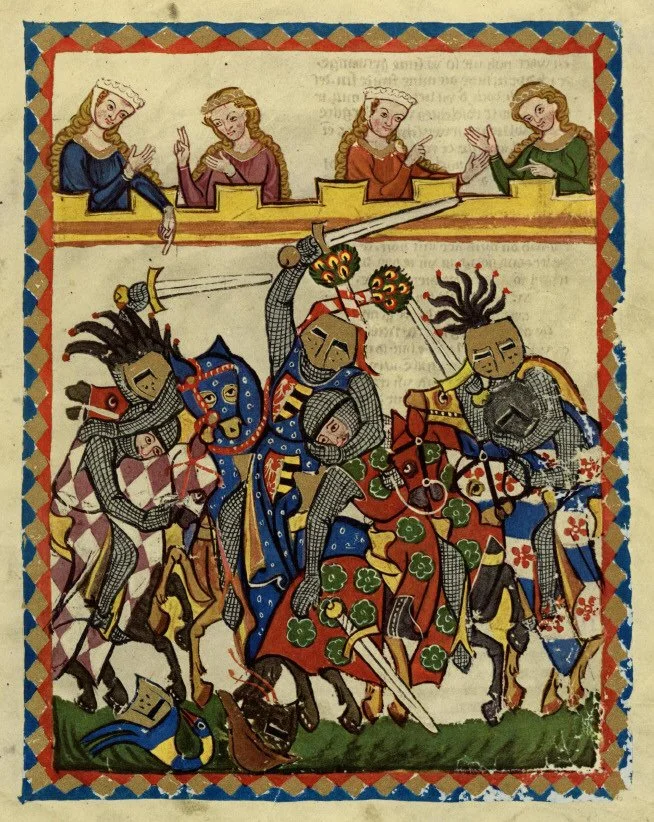
Knights being defeated in tournament by being caught in headlocks and having their helms torn form their heads, just as happene to Richard Marshal at Monmouth. (From The fourteenth-century ‘Manesse Codex’ (UB Heidelberg, Cod. Pal. germ. 848, fol. 17r).
Richard’s father's favoured tactic at tournament was a little different. His biography suggests that he captured his opponents by grabbing their reins before putting them in a headlock and tearing off their helmets, forcing their surrender. This was, of course, the very tactic Baldwin used against Richard, using such force that ‘blood gushed from his nostrils’.
When Wendover’s (arguably more famous) continuator and editor, Matthew Paris came to refresh the story, he chose to make it appear even more like a tournament encounter. His sketch of the battle has Richard Marshal unhorsing Baldwin with a lance-thrust, rather than the latter being struck by a crossbow quarrel, forcing him to flee the field fearing he had been mortally wounded.
Baldwin, in spite of his fears, was not to die on the field. Wendover tells us that of the 1000 knights in his force, fifteen men were captured by Marshal and led off as prisoners, whilst an unnumbered host lay dead on the field, Welsh, Poitevins ‘and other foreigners’. Of the Marshal's force, only three were led off captive, including one Thomas Siward - presumably a relative of Richard.
The Aftermath
In spite of his victory over Baldwin, Richard chose not to besiege Monmouth’s castle. instead he, Llewellyn, Basset, and Siward continued to launch raids and ambushes against the king’s troops, offering no quarter so that the whole region was tainted by the ‘numbers of dead foreigners who lay about on the road and other places’.
At the start of 1234 Richard went to his lands in Ireland. There he found his brother had brokered a truce with the king’s men in Leinster. Richard undid that, attacking the king’s Irish Justiciar, and spreading fear and chaos in much the same way that he and Siward had in England. In April he was cut off from his men and wounded fatally at the Battle of the Curragh, dying on April 15th, leaving his brother Gilbert to come to terms with the king and save the family’s fortunes.
Siward and Basset fared better. They made further raids through 1234, including one that came within four miles of capturing the king, securing their reputation.
WIth the death of Richard Marshal, these two notorious outlaws came to terms with Henry and, as the pendulum of courtly politics swung back in favour of Hubert de Burgh and away from Peter des Roches, both Siward and Basset were to find employment at the royal court. Siward was to serve the king in campaigns in Brittany, and was given the honour of bearing the golden sceptre at the coronation of Henry’s wife, Queen Eleanor. He spent a little time in the court of Alexander II of Scotland, before being granted lordship of Gower and Glamorgan, and gaining a lordship for himself at Tal y Fan near Cowbridge in the Vale of Glamorgan. His possession of this was disputed by the Earl of Gloucester, and the case was still before the king’s justices when Siward suffered a stroke and died in the winter of 1248.
It was not long after the Marshal’s rebellion that Henry III became free of the influence of both des Roches, who died in 1238, and de Burgh, who died in 1248. He could, however, not remove himself from the perception of being subject to foreign influence, and twenty years later would face rebellion once again, on a much grander scale, led by Simon de Montfort, Earl of Leicester.
